
All Food Processing is Not the Problem. Ultra-Processing Is
Commercial success is possible without conflicting with public health. The issue is to regulate food products that have the potential to cause harm to health.
Food processing per se is not the enemy. It never was.
For millennia, humans have processed real food to preserve it, make it safer and improve nutrition. Drying grains, fermenting milk, milling cereals, and cooking meals; all are processing techniques. These forms of processing underpin food security and public health. Most such processing methods kept the food matrix intact. An intact food matrix refers to a food whose natural physical structure and nutrient interactions remain largely unaltered, as found in whole or minimally processed foods.
Ultra-processed food products (UPFs) are fundamentally different; not real but industrial formulations of food substances and with broken food matrix. UPFs are often high in energy, sugars, salt and bad fats(HFSS). Junk food is a popular term to describe these.
Combined with additives, emulsifiers, colours and flavours, these are engineered for taste and convenience, to be rapidly consumed and easily over-eaten matching addicting. The primary purpose is not preservation or nourishment, but trade, more shelf-life and profitability via over-consumption. UPFs are in solid or liquid form, sold as pre-packaged and backed by aggressive marketing and advertisements. Evidence clearly shows increased consumption of UPFs is associated with obesity, diabetes and many other related non-communicable diseases.
There are voices that challenge their existence, its definition or the related evidence of harm or even call such food products to be healthy.
Distinction Matters.
Why ultra-processing is different? The real issue is not whether food is processed, but how and what is the purpose behind it. All pre-packaged food products can be identified to be processed or ultra-processed.
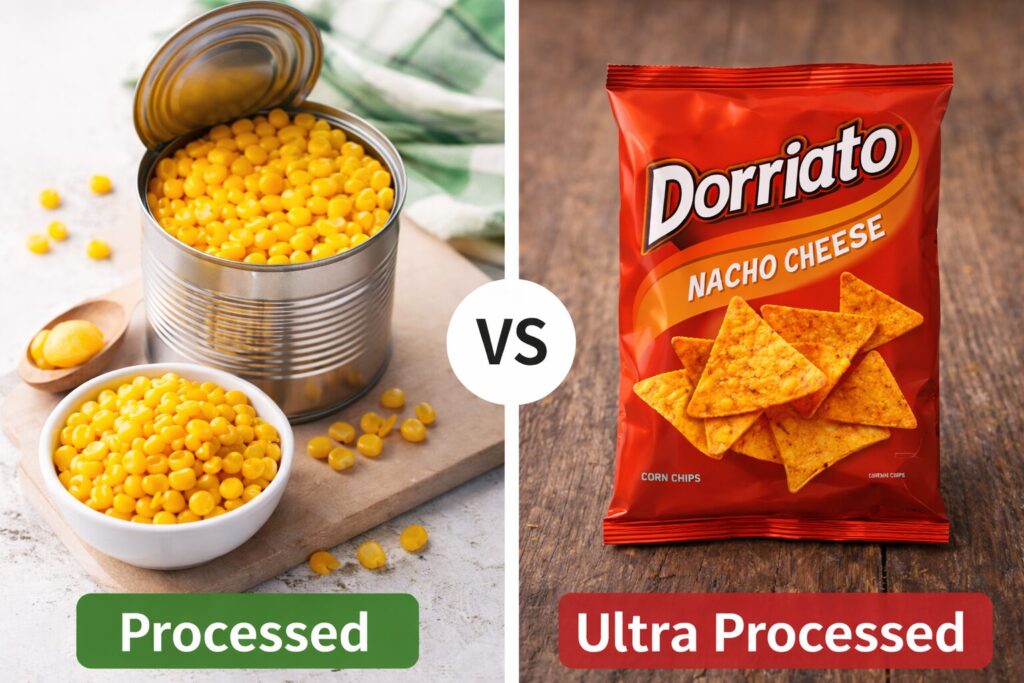
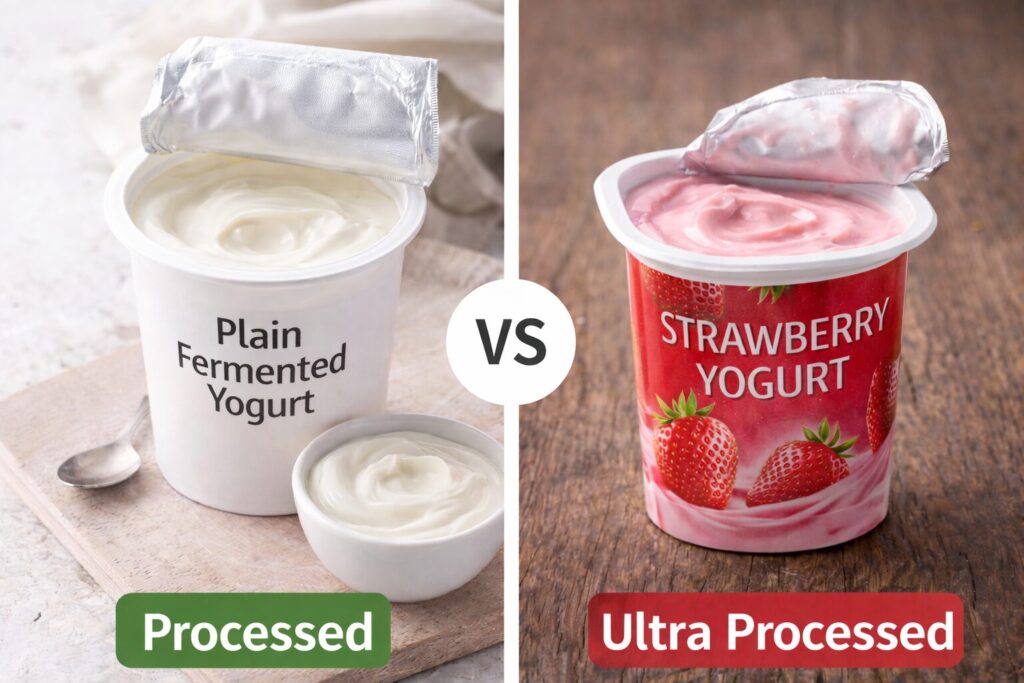
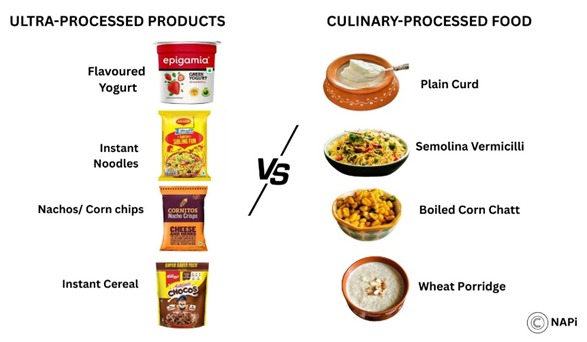
Let me explain with an example of Chips made from Corn. Chips available in market in pre-packaged form have undergone several processing techniques with added colours, flavours etc. Corn itself is not visible when you open a packet of chips. Compare it with a packet of corn, butter and slated or even given a lemon touch. Food matrix is intact, you can identify it is corn. Chips in this case are ultra-processed and salted corn is processed or non-UPF. Several other examples to understand this distinction are : fruit flavoured yogurt (UPF) vs plain or natural yogurt(non-UPF), packaged wholegrain bread with emulsifiers (UPF)vs freshly baked wholegrain bread(Non-UPF), fruit drinks (UPF) vs fresh fruit or its juice(Non-UPF), and instant noodles(UPF) vs traditional pasta (Non-UPF).
What is the Real Issue?
UPFs are loaded with refined carbs that are delivered rapidly to give a quick, intense but short-lived pleasure. It encourages consumption. This effect is reinforced by ubiquitous availability and aggressive marketing, often aimed at children and the youth.
Increased consumption is associated with health harms, a legitimate concern.
To equate these legitimate concerns about UPFs regarding their risks to human health with hostility to all processing; is, therefore, a false and unhelpful framing.
On the contrary, projecting UPFs as ‘healthy’ or ‘real food’ legitimises industry narrative, blurs the distinction and causes consumer confusion.
Is UPF a vague or unscientific concept? No.
A common argument being advanced, particularly by sections of industry uncomfortable with the term; is that UPFs lack a clear definition or sufficient scientific evidence.
We should be aware that a global shift of diet pattern is happening replacing real and cooked meals with UPFs. This claim does not withstand scrutiny. UPFs are defined using established classification systems, most notably the NOVA classification of foods by its degree of processing. It does adds a complementary layer to nutrient content, focused on food processing as a determinant of dietary patterns. Aim is to regulate UPFs, its crucial nutrients with markers of food ultra-processing, rather than treating processing as a stand‑alone metric. To tackle this global shift and effective policy action is required that would protect and restore diets based on fresh and minimally processed foods and cooked meals.
The definition of UPF does not rest on nutrient content alone, but on the nature, purpose, and extent of industrial processing. That is precisely why it has proved useful to conduct and document hundreds of research evidence showing that these are overconsumed, and lead to gain in weight.
The Evidence or its Uncertainty
Large prospective cohort studies across multiple countries consistently associate high UPF consumption with increased risks of obesity, type 2 diabetes, cardiovascular disease, certain cancers, depression, mental health problems, and all-cause mortality. Crucially, these associations persist even after adjusting for calories, fat, sugar, and salt, indicating that the structure and degree of processing, not just their nutrient profiles, influence health outcomes. Evidence shows that when dietary pattern changes with lesser quantity of UPFs, intake of sugars and salts drops significantly.
Even if there is uncertainty, regulating these food products as UPFs or HFSS becomes a necessity. This is ratified in the FSS Act 2006’s general principles. Section 18.1.c says “..where in any specific circumstances, on the basis of assessment of available information, the possibility of harmful effects on health is identified but scientific uncertainty persists, provisional risk management measures necessary to ensure appropriate level of health protection may be adopted, pending further scientific information for a more comprehensive risk assessment..”
The evidence has been reviewed and used by as many as 29 public health interest organisations and country’s leading Economic Survey 2025-26 recommending strong marketing controls on UPFs.
Reframing the Debate
Questioning whether ultra-processing itself is a meaningful concept, risks obscuring the central issue, which is public health. Fortification does not automatically makes a product healthy if the product whose industrial formulation is explicitly designed to drive frequent and excessive consumption.
Scientific scrutiny has moved beyond whether ultra-processing exists, to how it shapes eating behaviour, shifts diet patterns and impacts population health.
Why ‘Consumer Choice’ is not a Policy Answer?
Another frequent response is that consumers can simply choose not to eat unhealthy food products. When UPFs dominate retail shelves, are cheaper per calorie, heavily advertised, algorithm driven and more importantly these are engineered to be addictive, placing the entire burden on individual choice is neither realistic nor fair.
This is especially true for children, who are uniquely vulnerable to marketing and habit formation. Public health policy safeguards have to exist precisely because markets do not automatically protect long-term health interests.
Innovation and Way Forward
There is, however, a constructive path forward, one that industry should view it as an opportunity rather than threat. Instead of disputing the concept of ultra-processing, food companies may like to focus attention and better learn what is not ultra-processed. (Non-UPF) Minimally processed and traditionally processed foods form the backbone of healthy diets across cultures. There is enormous economic scope for innovation and investment in these categories. Improving affordability, convenience, shelf-life, and distribution without resorting to breaking food matrix and biological manipulation makes future ready foods.  Recently, ‘Mark and Spencer’ introduced the corn flakes with only one ingredient. Many MSMEs in India have demonstrated such an ability to process and sell foods which are Non-UPFs. The system should incentivise them to scale up. Fermented foods, whole-grain products, minimally processed dairy and vegetables, and culturally rooted local foods offer clear growth potential. Supporting these foods aligns commercial success with public health, rather than placing the two in conflict.
In conclusion, the debate on ultra-processed foods is not ideological, anti-industry, or anti-science. It is about recognising a distinct category of food products whose design and marketing create predictable risks, and the State must prevent this risk to their population.
All processing is not bad. But pretending that ultra-processing is just more of the same, is misleading and a mistake we can no longer afford. Key question is which food product can be harmful and what a dietary pattern should ideally be?
India has not yet shifted heavily toward relying on ultra-processed foods in its dietary patterns, but the growth of UPFs is something that cannot be ignored. It is now up to the Government of India and its regulators to act in the best interests of the people they are mandated to serve.
Dr. Arun Gupta MD, Pediatrics
Convenor, Nutrition Advocacy in Public Interest (NAPi)
Dr. Nupur Bidla, PhD, Social Work
Member, Nutrition Advocacy in Public Interest (NAPi)