Food Safety Law Defines ‘Low Sugar’ and ‘Zero Sugar’ — Why Not ‘High Sugar’?
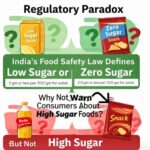
It is a striking irony in India’s food regulation that the law clearly defines what qualifies as a “low sugar” or “zero sugar” food product, allowing companies to prominently display such claims on the front of packages to help sell more their products. Yet the same regulatory framework hesitates to define “high sugar” and require that information to be disclosed to consumers.
Is it fair to the people of India that food companies can highlight positive claims like “low sugar” on the front of packs, while consumers are not equally informed when sugar levels are high?
The Ministry of Health and Family Welfare has repeatedly acknowledged that unhealthy diets are a major driver of India’s rising burden of non-communicable diseases (NCDs), including diabetes, obesity and cardiovascular disease. Particularly worrying is the increasing incidence of these conditions in younger age groups.
The Government of India’s Economic Survey 2025-26 has also recognised the need for stronger regulatory measures to address High Fat, Sugar and Salt (HFSS) foods and ultra-processed food products, popularly called junk foods. Members of Parliament have similarly raised concerns about policy gaps that contribute to the overconsumption of such products.
Yet the policy debate around sugar and food regulation often drifts into technical arguments about definitions, individual choice, or claims of insufficient evidence. Such points are frequently raised by sections of the food industry to oppose warning labels on HFSS products. Even the widely used nutrient threshold model of per 100 grams, developed by the National Institute of Nutrition (NIN), has been criticised as flawed.
Such framing risks obscuring the central public-health issue.
Evidence linking the growing consumption of pre-packaged HFSS and ultra-processed foods to NCDs is now extensive and consistent, as documented in the recent Lancet Series on Ultra-Processed Foods and Human Health. Nutrient thresholds expressed per 100 grams or millilitres are internationally recognised and part of the existing food safety law. It provides a standardised basis for regulation.
The real policy question is therefore not whether these products should exist, but how they are marketed and promoted in a rapidly changing food environment dominated by highly processed products backed by aggressive advertising.
The case of sugar illustrates this problem clearly.
A Regulatory Paradox
At the centre of the debate lies a striking regulatory paradox. India’s food law already recognises the concepts of “low sugar” and “zero sugar.”
Under regulations framed by the Food Safety and Standards Authority of India (FSSAI), a manufacturer can claim that a product is low in sugar if it contains not more than 5 grams of total sugars per 100 grams of solid food or 2.5 grams per 100 millilitres of liquid.
Similarly, a product may claim to be “sugar free” if it contains not more than 0.5 grams of sugars per 100 grams or 100 millilitres.
These provisions reflect an important underlying principle: nutrient thresholds matter, and consumers benefit from clear information about them. Unsurprisingly, “low sugar” or “zero sugar” claims are widely used by food companies as marketing tools and prominently displayed on front-of-pack labels (FOPL) to project products as healthier choices.
Implicit in this regulatory logic is another truth: high sugar intake can pose health risks. It leads to an obvious question. If regulators can define and promote “low sugar”, why hesitate to define “high sugar” and disclose that information equally clearly to consumers?
The Added Sugar Loophole
Another complication arises from how sugar is currently addressed in regulatory discussions.
In its submissions before the Supreme Court of India regarding front-of-pack labelling, FSSAI has proposed thresholds for foods high in added sugar, salt and saturated fat.
However, focusing only on added sugar creates a significant loophole.
Many pre-packaged food products derive sugar from multiple sources—refined sugar, syrups, fruit concentrates and processed ingredients that ultimately increase the total sugar load of the product. When regulation targets only added sugar, manufacturers can adjust formulations while still delivering high levels of total sugar exposure to consumers.
Moreover, in practical terms laboratory analysis can reliably measure total sugar, not added sugar.
From a public-health perspective, what matters most is not the technical pathway through which sugar enters a product but how much sugar people ultimately consume.
Humans do not metabolise “added sugar” differently from other forms of sugar. Our bodies respond to total sugar intake. A regulatory framework that focuses only on added sugar therefore risks underestimating the real sugar burden.
An Expanding and Addictive Food Environment
India’s food environment is changing rapidly.
The market for pre-packaged food products has been expanding at a compound annual growth rate of around 13.3 percent, growing dramatically over the past decade and a half. Intensely flavoured and highly palatable products such as biscuits, sugary beverages and confectionery are among the most common HFSS foods.
These products are not accidental combinations of ingredients. They are developed using sophisticated food technology designed to optimise taste, texture and consumer appeal.
Sugar plays a central role in this process. It is not only a sweetener but also a structural ingredient that influences mouthfeel and flavour delivery. Often it is combined with fats, refined starches, flavour enhancers and aromatic compounds that intensify the sensory experience of eating.
Such formulations stimulate the brain’s reward pathways, reinforcing repeated consumption. Sweetness, aroma and texture create powerful sensory cues that encourage people to keep eating. In effect, these foods are designed to be highly palatable and habit-forming.
Advertising Power
This engineered palatability is reinforced by massive advertising investments. A report from the World Health Organization’s India office, monitoring television advertising, found that food companies spend around ₹170 crore every month promoting food products across ten major television channels, generating nearly 200,000 advertisements each month.
These advertisements emphasise taste, convenience and lifestyle appeal. Associations with sports create a health halo. Celebrities are frequently used to endorse products. Children and adolescents are among the most exposed audiences. Marketing extends beyond television to cinema halls, billboards, digital media, school and college canteens, often accompanied by deep discounts and promotional offers.
Against this backdrop of constant promotion, consumers receive relatively little clear information, either in advertisements or on front-of-pack labels, to help them quickly assess the health implications of what they are buying.
The Role of Warning Labels
This is precisely where regulatory tools such as warning front-of-pack labels become important.
Clear and truthful information displayed prominently on food packages allows consumers to understand the nutritional profile of products quickly and easily at the point of purchase. Such labels do not ban products; they simply restore balance in a marketplace dominated by persuasive marketing.
The Way Forward
The principle of nutrient thresholds per 100 grams or millilitres is already embedded in Indian regulation through provisions allowing low-sugar and zero-sugar claims.
If food companies can use these thresholds to market their products, it is only reasonable that consumers should also be informed when sugar levels are high.
At the same time, thresholds used for regulatory purposes should rely on total sugar, not merely added sugar, so that the full sugar burden of products is not obscured.
Public health and ease of doing business need not be in conflict. Transparent information empowers consumers, encourages healthier product reformulation and supports a food system that promotes both economic growth and population health.
Dr Arun Gupta MD
Pediatrician and Convenor
Nutrition Advocacy in Public Interest (NAPi)