Who Defines Food Innovation — Public Health or Corporate Interest?
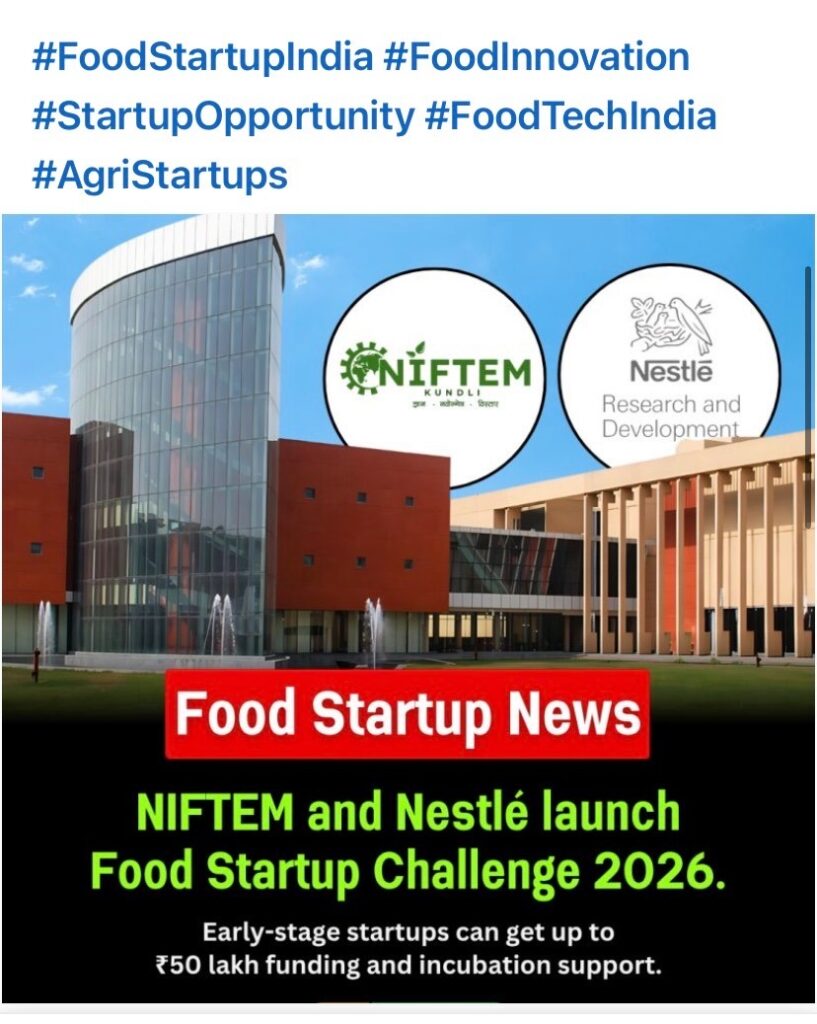
When a government institution partners with a multinational food corporation to define “nutrition innovation,” the issue is not just about collaboration; it is conflict of interest.
This is about recent partnership between the National Institute of Food Technology Entrepreneurship and Management (NIFTEM-K), under the Ministry of Food Processing Industries (MoFPI), with a multinational food corporation Nestlé Research and Development (R&D). It designed for start-ups in food and agri-business with a funding support of up to ₹50 lakh and offers incubation support, expert mentorship and access to industry network and infrastructure. Focus areas are ‘Protein for all’, ‘Nutrition for every pocket’ and ‘Wellness, functional and indulgence beverages’.
Food Governance
It may appear progressive and modern on the surface but who defines innovation, and in whose interest. That needs answers in any governance, food is no exception. It also raises concerns that go beyond start-up support highlighting a conflict of interest. NIFTEM aligns with a commercial actor, whose business models may conflict with public health goals. It assumes importance because Financial times reported in 2021, “Nestlé, has acknowledged that more than 60 per cent of its mainstream food and drinks products do not meet a “recognised definition of health” and that “some of our categories and products will never be ‘healthy’ no matter how much we renovate”.
Has this issue been factored in the decision ? I don’t know.
When Nestle partners in a nutrition innovation challenge, what is likely outcome of production. Minimally processed foods, which is small portfolio of this company or commercially formulated and pre-packaged ultra processed food products, which is its major portfolio across the world.
It makes me wonder why are food innovation themes framed around nutrient delivery and functional products, rather than scaling up access to minimally processed food systems, local diets, or whole-food. This debate is not about opposing food processing. It is about whether public institutions should help shape markets for ultra-processed products under the language of innovation.
The concern becomes clearer when we examine the selected focus areas. These themes are not problematic in themselves. The issue lies in the likely pathways through which they may be and commercialised. Let’s examine these.
“Protein for all”
This could go in two very different directions either minimally processed such as pulses, lentils, millets, nuts, fermented foods, minimally processed dairy or egg-based products. It may go the other way, which is more likely given the commercial nature. UPFs such as protein powders, fortified snack bars , high-protein beverages, protein-enriched biscuits, cereals, or puffs etc. The phrase “for all” often implies scalability. That would need shelf stability, portability, and convenience. These features suit the UPF pathway with industrial processing using cosmetic additives.
Nutrition for every pocket
It could mean affordable fresh food access , low-cost whole grains , community food systems, and locally sourced minimally processed staples. But all this may not need the proposed technology or industry networks. Its industrial formulation could be low-cost fortified packaged foods, or small sachet-based nutrition products easy to replace meals. To reach wider markets they may be backed by marketing budgets.
Wellness, Functional and Indulgence Beverages
This category has the strongest likelihood of being UPFs. “Functional beverages” often include fortified drinks ,flavored protein beverages, probiotic drinks ,vitamin-added beverages, energy or wellness drinks, or sweetened “health” drinks. “Indulgence beverages” , the name strongly suggests products optimized for taste and repeat consumption. These are marketed using health and wellness claims to increase profitability. These would likely fall under ultra-processed food products depending on additives, flavours, colours, emulsifiers, sweeteners, stabilisers etc.
Visible Shift
Food processing is no longer framed only as preservation or value addition. Increasingly, it is tied to “nutrition innovation,” wellness markets, and commercially driven product ecosystems.
The real concern is the rapid expansion of ultra-processed food products already happening in the country as Economic Survey 2025-26 points out that it has risen 40-fold in past 15 years and linked to obesity showing a parallel rise. Such strategies may only help fuel it.
When food product formulations are designed for scalability, market penetration follows. This is often backed by aggressive branding, health and wellness positioning, and extensive marketing.
Several risks emerge
- Commercial interests may shape research and startup priorities, “Wellness” and “functional” narratives can shift attention away from whole foods and healthy dietary patterns.
- Food industry gains legitimacy through association with government credibility.
- Opposition to scientific evidence regarding ultra-processed food consumption on human health.
- Loss of independence of public institutions.
Questions Worth Asking
If government institutions are investing into food innovation, then we ask if similarly funded start-up grants could come up to develop and scale ‘breastfeeding support systems’, healthy whole-food retail models in communities, minimally processed foods rooted in traditional diets and local agriculture, preserve small whole-food businesses, and prioritising fresh foods and local supply chains.
In conclusion, India does not need to choose between innovation and public health. It can support food entrepreneurship too. India is witnessing rapid growth in ultra-processed food consumption alongside rising obesity, diabetes, cardiovascular disease, and childhood dietary transitions. In this context, institutional neutrality becomes more important, not less.
Dr. Arun Gupta MD, Pediatrics
Convenor, Nutrition Advocacy in Public Interest (NAPi)