Food Product Marketing Policy and South–South Cooperation
Shouldn’t People in the South Demand Fairness when the North Dominates in the Production and Marketing of Unhealthy Ultra Processed Food Products, and Pushes these to the South given that they are stagnant in the North ? We use the India, Mexico and Brazil example to explain or view.

Arun Gupta and Phil Baker
The Big Picture
Worldwide ultra processed food product (UPF) consumption is rising sharply. Analyses of Euromonitor International's food sales data from 93 countries, showed that annual per capita sales of UPFs increased by 40% in lower-middle-income countries and by nearly 20% in upper-middle-income countries, when overall sales of UPFs in high-income countries remained stable[1]. (Fig.1) The UPF industry grew first in high-income country markets, but as sales stagnated in those markets, it pushed its products into middle-income and low-income countries using sophisticated marketing techniques. This helped them to sustain growth and profitability. Between 2009 and 2023, global UPF market sales grew from US$1.5 trillion to $1.9 trillion.[2] Researchers have noted that rising rates of obesity and diet-related diseases have occurred on a similar timeline as industry-driven changes in the global food system creating dominance of UPFs in diet[3].
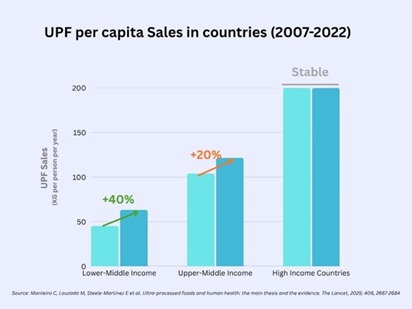
Fig. 1 The Big Picture : UPF sales per capita in lower and upper income nations
According the analysis in the Lancet, some countries like India, Vietnam, Uzbekistan, and Laos are among the fastest growing markets. (Fig. 2)
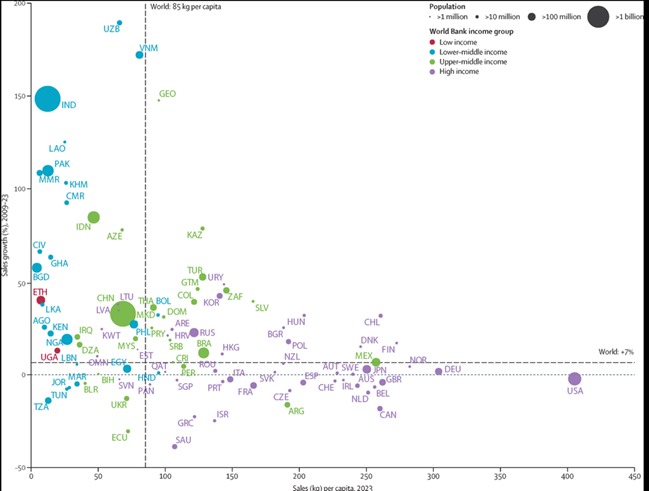
Fig. 2. Country-level sales of ultra-processed foods and beverages per capita versus growth, 2009–23(Courtesy: Lancet Series on Ultra -processed Foods and Human Health)
UPFs and Food Cultures
Ultra-processed foods not only harm our health. They also threaten diverse food cultures of Southern Nations including India , their agricultural traditions and culinary knowledge, which are among the richest in the world. From millets and pulses to regional cuisines shaped over centuries, these countries have long sustained diverse, nutritious and localised food systems. The rapid expansion of UPF corporations further erodes their food sovereignty, economic self-reliance and cultural heritage.
As global corporations seek to reshape diets of people in the South, in pursuit of profit, protecting traditional foods becomes part of protecting countries, including their farmers, families, biodiversity and cultural cuisine. Resisting UPFs is therefore not about rejecting modernity, but about ensuring that India and other nations’ future is built on national strength, nutritional security, and democratic control over its own food system, rather than dependence on multinational corporate interests.
Aggressive Marketing Aggravates the Problem
Aggressive marketing creates an imbalance. According to the Lancet Series, UPF production and distribution costs are cut down by replacing more expensive ingredients with cheaper modified substitutes. Resources are made available freely for large expenditures on marketing, including branding, promotion. In 2024 alone, Coca-Cola, PepsiCo, and Mondelez spent a combined $13·2 billion on advertising, which is about four times WHO's operating budget. This power in food systems makes all the difference to generate demand and normalise consumption of unhealthy products.
A WHO-India study reported that approx. 200,000 food product advertisements are flashed each month on 10 select channels and print media. UPFs are promoted extensively through television, digital platforms, influencers, and sports sponsorships, often targeting children and young people.
The UPFs are engineered for high palatability and overconsumption, yet the health risks associated with excess sugar, salt, and unhealthy fats remain largely invisible in marketing and insufficiently visible on packaging. The consumer, therefore, encounters a skewed information environment, which amplifies appeal of food products but downplays risk.
Can India join Brazil and Mexico ?
India shows a 40- fold rise in consumption of UPFs over past 15 years. These are mostly high is fats/sugars and salt(HFSS) and sold as pre-packaged. This situation is fuelling the epidemic of obesity and diabetes. Over 100 million people living with diabetes and 250 million overweight or obese, making it one of the largest contributors to the global burden of the disease.
At a time when diet-related diseases are rising rapidly and pre-packaged foods are becoming a dominant part of everyday diets, a simple question demands attention. Should Indian people and those in other Southern nations demand protection from marketing of UPFs.
The energy contribution of UPFs to total household food purchases or daily food intake increased (10% to 23%) in Mexico and Brazil over past four decades. Across the Global South, countries such as Brazil, Chile , Mexico and others have introduced policies to reduce consumption of UPFs. These include front-of-pack warning labels on foods high in sugar, salt, and unhealthy fats, taxes, and advertisement restrictions. Warning labels are simple, visible and designed to inform consumers the nutrition risk at the point of purchase. In contrast, Indian consumers are still expected to rely on dense nutrition tables and technical ingredient lists printed in small fonts on the back of packages; this is difficult to interpret , however may comply with rules. Indian consumers , in solidarity should demand warning information on the front of the packaged food products. This is not merely a matter of labelling design. It is a question of fairness, transparency, and public health.
Brazil and Mexico, like India, are large middle-income economies with rapidly changing food environments, rising burdens of obesity and diabetes, and increasing consumption of pre-packaged UPFs or HFSS. They also face a “double burden” of malnutrition, where undernutrition coexists with diet-related chronic disease. These shared conditions make their policy choices particularly relevant. In addition these and other countries in the South deserve protection from commercial drivers of consumption.
Why South-South Cooperation?
While most large food corporations are headquartered in the Global North, the fastest-growing markets, and the greatest health impacts, are in the Global South. In this context, front-of-pack warning labels or advertising restrictions are not just technical tools; they are policy instruments through which countries can assert regulatory space to protect population health. This information inequality needs to be tackled.
The eight largest transnational UPF manufacturers, by share of total industry revenue, are headquartered in North America and western Europe: Nestlé (Switzerland), PepsiCo (the USA), Unilever (the UK), Coca-Cola (the USA), Danone (France), Fomento Económico Mexicano (Mexico), Mondelez (the USA), and Kraft Heinz (the USA).
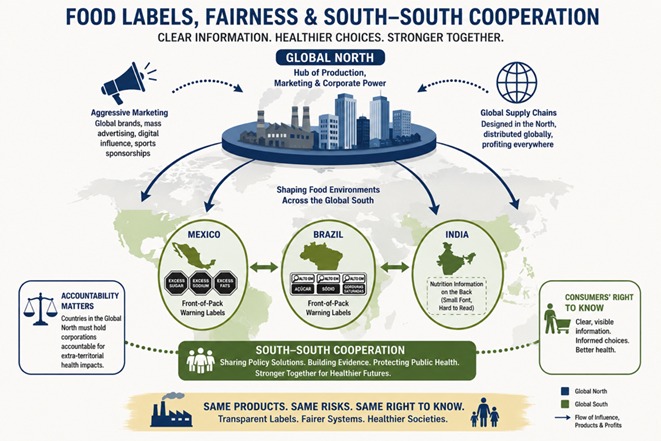
Fig. 3 Brazil, Mexico and India (Image Credit ChatGPT)
This also raises a parallel question of accountability. The food corporations headquartered in the Global North[4], having huge economic and political power, shape food environments across the Global South. UPF corporations use sophisticated political strategies to protect their profitability – by blocking regulation, shaping science, and influencing public debate. Thy fund a global network of 207 interest groups to lobby governments. UPF companies initiate partnerships with the government departments, NGOs and experts to position themselves as ‘part of the solution’. This ends up promoting corporate friendly policies and oppose regulations.
In this context, South–South cooperation is not merely collaboration, but a necessary counterbalance. There is a corresponding responsibility for their home countries to ensure that public health harms are not externalised.
Not a Banon Sale but on Promotion
Front-of-pack warning labels or advertisement restrictions seek to correct this imbalance. They do not prohibit sale of products or restrict consumer choice. Rather, they ensure that consumers receive clear, immediate, and understandable information before making a decision to buy. Evidence from multiple countries suggests that such labels improve awareness, support healthier choices and effectively reduce consumption of HFSS.
India and many countries in the South today stand at a critical juncture in its food transition with increasing diet-related chronic diseases, for which action has to be taken to halt the trend of rising consumption of UPFs.
This is a call to the countries the south to provide clearer warning information, to your citizens and restrict advertisements of UPFs. It will be a BIG step forward to counter balance the power of the BIG FOOD of the north.
Arun Gupta MD (Ped),
Convenor, Nutrition Advocacy in Public Interest(NAPi), India
Phillip Baker
Associate Professor, ARC Future Fellow and Horizon Fellow
Charles Perkins Centre and Sydney School of Public Health, Faculty of Medicine and Health, The University of Sydney, Camperdown, NSW 2006
________________________________________
[1] https://www.thelancet.com/journals/lancet/article/PIIS0140-6736(25)01565-X/fulltext
[2] https://www.thelancet.com/journals/lancet/article/PIIS0140-6736(25)01567-3/fulltext
[3] Swinburn BA, Sacks G, Hall KD, McPherson K, Finegood DT, Moodie ML, et al. The global obesity pandemic: shaped by global drivers and local environments. Lancet. 2011;378(9793):804–14.
https://pubmed.ncbi.nlm.nih.gov/21872749/
[4] https://www.thelancet.com/journals/lancet/article/PIIS0140-6736(25)01567-3/fulltext