Do Junk Food Ads Qualify as “Free Speech”?
Do Junk Food Ads Qualify as "Free Speech"?
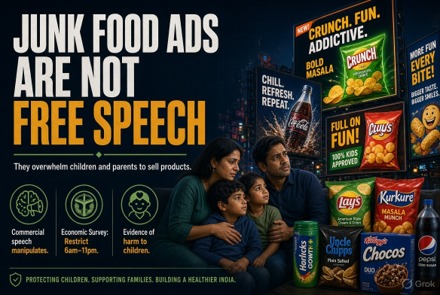
As the Economic Survey 2025-26 recommends restricting junk food ads from 6am to 11pm, the food industry may invoke a free speech defense as seen in the USA. Even if it is done, India should not wait, given that judicial understanding exists despite that public health is absent in the list of reasonable restrictions under Article 19(2).
When tobacco companies faced advertising restrictions in the 1950s, they made a calculated move. They argued that advertising was speech and that restricting it violated their constitutional rights. It worked for decades. In 1978, when the US Federal Trade Commission proposed sweeping regulations on junk food marketing to children, the food industry convinced Congress to block it . The 2026 US example shows how the food industry continues to use the free speech argument as a powerful threat in legislative battles. These examples show a consistent strategy to frame any restriction on junk food marketing as a First Amendment violation.
India now stands at a similar crossroads. The Economic Survey 2025-26 has recommended banning ads of ultra-processed food products(UPFs) or so called junk food from 6am to 11pm. If India did implement this, will the food industry invoke free speech argument? This threat should not bother the policy makers and be a reason not to regulate. Rather, it should become a reason to enact it sooner.
The Constitutional Question
Can commercial advertisements for junk food qualify as "free speech" under the Article 19(1)(a) that grants citizens the right to freely express their thoughts, opinions, and ideas? Restrictions on this right are only permitted if they are within the ambit of the list of reasonable restrictions under Article 19(2), under which public health is notably absent.
If junk food advertising is not treated as free speech, regulation becomes far more feasible.
How Advertising Differs from Speech?
Free speech exists to express ideas, opinions and or dissent. It contributes to democratic dialogue and free exchange of ideas, even controversial ones. Commercial advertising exists to sell products. It is a paid, promotional activity and its impact is usually measured by sales. In the case of food or beverage products, it targets people, manipulates behaviour and even promotes overconsumption by glamorizing the product.
The Indian Precedent
In India, tobacco companies did invoke Article 19(1)(a) to resist advertising restrictions. In Mahesh Bhatt v. Union of India (2008), the Delhi High Court upheld the ban, ruling that advertisements solely promoting commercial interests do not qualify for Article 19(1)(a) protection. The Court emphasized the government's constitutional duty to protect health under Article 21 and Article 47. Through the doctrine of ‘harmonious construction’, a purposive interpretation evolved to circumvent the omission of public health as the tobacco industry argued that Article 19(2) does not include "public health".
Consider this argument for junk food advertising that increases its consumption and associated with harm to human health. This commercial speech should definitely not qualify for free speech protection. The case for banning junk food ads is stronger as it does not serve any public interest.
What Junk Food Ads Do?
Junk food advertising displaces traditional diets with unhealthy food products. It conceals information about sugars, salt and or fats, thus masking harmful health consequences. Many a times advertisements projects these products as healthy. It manipulates young minds by associating unhealthy foods with fun, being cool or sports success. It may also target low-income families by positioning small junk food packets as value for money. Sugary drinks have been marketed by projecting traditional ingredients like jeera(Cumin seeds). Traditional drinks like lassi ( Yogurt drink) or nimbu pani( Lemon drink) , belonging to small and local economies, are not marketed or advertised at all.
The Evidence of Harm
The evidence is overwhelming. Children regularly exposed to food advertising consume 45% more unhealthy snacks immediately after exposure. Children exposed to sugary cereal ads are twice as likely to request those products during grocery shopping.
Unhealthy food marketing directly alters children's food preferences, increases consumption of ultra-processed food products, and drives childhood obesity and non-communicable diseases (NCDs). UPFs are deliberately manufactured to be hyper-palatable and addictive. A BMJ study showed that UPF intake is linked to a heightened risk of several major chronic health issues, such as digestive diseases, high blood pressure, and metabolic syndrome/diabetes, as well as death. Every extra 100 g consumed was associated with correspondingly greater risks.
Yet advertising continues largely unchecked and underlines urgency of a regulation.
Way Forward
UPF marketing warrants similar restrictions as for Tobacco products as unhealthy diet has overtaken tobacco to be the leading global risk factor for mortality. Global experience shows that nagging people to eat healthy has not worked for decades as obesity continued to rise. What governments needed to do is change the food environment that has shown to work in a short period. Chile's ban on child-directed junk food advertising reduced purchases of unhealthy products within a year.
What India Must Do
Enact statutory regulation of UPF/HFSS advertising, especially targeting children, and stop all such ads between 6am and 11pm on Television, print, online, OTT, or any digital medium as recommended by the Economic Survey2025-26.
While the Courts have used Article 21 and 47 in favour of protecting public health in India, as a long-term solution, it may be helpful to amend Article 19(2) to explicitly include "public health interest" as a ground for reasonable restriction. This will forever restrict commercial advertisements of food, tobacco or other products that may cause harm to human health.
The question is not whether we can afford to regulate junk food advertising. The question is whether we can afford not to.
I invite public health and consumer experts to join the discussion.