
The Warning That FSSAI Refuses to See
A new Mumbai study proves warning labels work best for Indian adolescents. Why is FSSAI still giving us a math problem instead of a warning?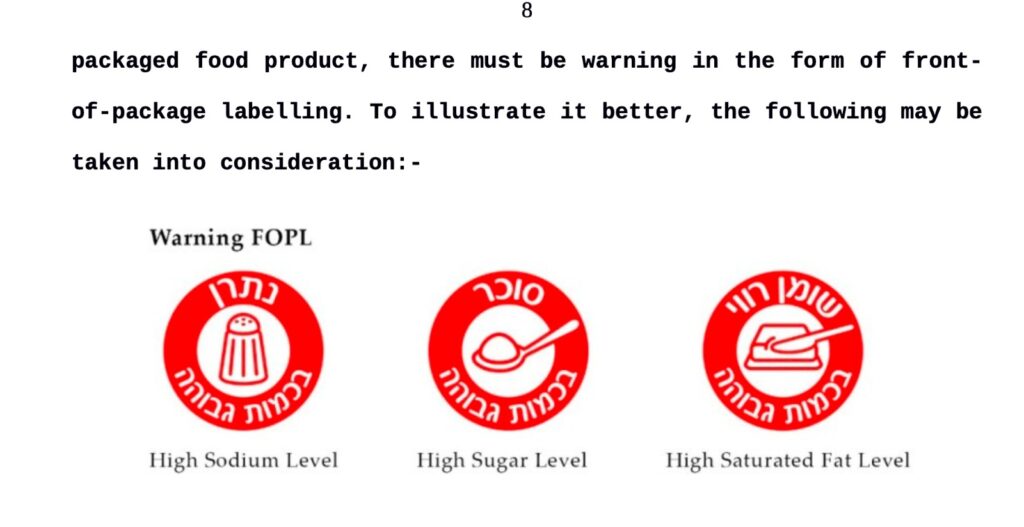
On February 10, 2026, the Supreme Court of India did something highly unusual in response to a PIL W.P.(C) No. 437/2024 by 3S and Our Health Society Vs Union of India, demanding warning labels on the front of the food / beverage product packages indicating if these are High in Sugar/salt or fats. Frustrated by years of bureaucratic inertia, the Bench did not merely issue a verbal directive to the Food Safety and Standards Authority of India (FSSAI) but showed a visual mock-up in its order. It was a stark, explicit front-of-pack warning label designed to alert consumers if a product was "High in Sugar," "High in Salt," or "High in Saturated Fat."
The message was unambiguous.
The Court noted that " …whatever exercise has been undertaken so far has not yielded any positive or good result…” and linked the issue directly to the constitutional "right to health" of citizens, and granted FSSAI four weeks to revert. Four months later, FSSAI has filed its compliance affidavit. And it has done everything except comply.
In its latest proposal, the Authority has abandoned the interpretive warning label suggested by the Court and instead proposed a non-interpretive FOPL, tabular declaration of the government's own recommended daily dietary allowances, which is 25 grams of added sugar, 10 grams of added saturated fat, and 5 grams of salt; to be displayed alongside serve size information. On its face, this appears to be a move toward transparency. In reality, it is a complex mathematical puzzle that citizens would have to go through. It fundamentally undermines the very purpose of front-of-pack labelling.
Let us be clear: asking a consumer to calculate how a 50-gram snack fits into a daily allowance of 25 grams of sugar is not "informed choice." It is forced calculation. For a population as diverse as India's, with varying levels of literacy and numeracy, a numerical table is a barrier, not a solution. The Supreme Court asked for an immediate, intuitive warning. FSSAI has offered a homework assignment.
The Missing Definition of HFSS
The most glaring omission in FSSAI's affidavit is to define what constitutes a High Fat, Sugar, and Salt (HFSS) food product. Any credible FoPNL regulation must begin with a threshold, a nutrient profile based on the composition of the food product per 100 grams or per 100 millilitres of nutrients of concern. I like to remind that FSSAI did provide the definition in Draft notification of 2022.
What has changed? Without this definition, the entire exercise is a regulatory sham.
This becomes particularly egregious when FSSAI claims to harmonise with the recommendations of the ICMR-National Institute of Nutrition's Dietary Guidelines for Indians (DGI), 2024. Yet, it has conveniently ignored all of it, especially the Table 15.1 of the same guidelines, which explicitly provides thresholds for sodium, added and total sugar , added and total fat per 100 grams of the product. FSSAI has cherry-picked the daily limits while discarding the product-specific thresholds that are essential for effective labelling. This is not alignment but a selective reading to suit a pre-determined, industry-friendly outcome.
Catering to Industry, Ignoring the Public
Why has FSSAI taken this regressive step? The answer lies in the Authority's own admission. In its affidavit, it notes that during a stakeholder consultation on March 19, 2026, the "majority of the industry organizations were against the inclusion of 'warning labels' on the product." The industry's favoured approach, the affidavit records, was to ensure "informed decision without creating fear."
This is revealing and suggests that FSSAI is not assessing policy based on public health outcomes, but rather on the commercial discomfort of the food industry.
The industry does not fear "labels"; it fears "warnings". Because warnings work.
I had attended this consultation on the invitation of FSSAI and saw all industry representatives opposing the warning labels. Furthermore, when the Authority's CEO invited written comments from us , and I submitted on behalf of 29 groups’ science-backed representations. These were largely ignored to accommodate the food industry's demands.
The Game-Changer: New Evidence from Mumbai
Until now, evidence from India was available on study conducted on adult population. A landmark new study, published in the peer-reviewed journal World Nutrition, has come out with Indian data on adolescents. A young researchers conducted a randomised controlled experiment in Mumbai with 120 adolescents aged 13 to 18, comparing four FOPL formats: Warning Labels, Health Star Rating (HSR), NutriScore, and a control group with no front-of-pack label. The results were nothing short of definitive.
Adolescents presented with Warning Labels chose the healthier product 80.0% of the time. In contrast, those using Health Star Rating chose healthier products only 66.7% of the time. NutriScore performed even worse at 56.7%. The control group, with no front-of-pack guidance, chose healthier products just 33.3% of the time. The difference was statistically significant with a large effect size. Warning Labels also produced the fastest decision-making and the highest comprehension scores among all participants.
This is Mumbai data. Indian adolescents, the very group most vulnerable to junk food marketing and impulsive purchases, overwhelmingly responded to the simplicity and clarity of a direct warning. If warning labels work best for teenagers, who are the most susceptible to marketing manipulation, they will work for every Indian consumer.
FSSAI's proposed tabular format asks consumers to perform mental arithmetic at the supermarket shelf. This study proves that consumers value clarity and simplicity over comprehensiveness. A numerical table is not informed choice. It is a barrier to choice.
A Pattern of Systemic Resistance
This is not an isolated incident of bureaucratic foot-dragging. FSSAI's resistance to warning labels represents a broader pattern of ignoring higher policy mandates. The Authority has repeatedly overlooked:
- The National Multisectoral Action Plan (NMAP) 2017 of the Ministry of Health and Family Welfare, which prioritized non-communicable disease (NCD) prevention through reducing unhealthy diets and one key recommendation was interpretive FOPL.
- The Economic Survey 2025-26, which specifically recommended clear front-of-pack labels to combat the rising burden of obesity and diabetes.
- The recent, clear recommendations of the Parliamentary Committee on Consumer Affairs, which called for stringent, easy-to-understand warning labels.
- The repeated representations from Members of Parliament identifying the policy gap in the Parliament.
By ignoring these institutional signals and the policy gaps, FSSAI is not acting as an independent regulator; it is acting as a captive of the very industry it is meant to regulate.
The Supreme Court's February 10 order was not just a suggestion but it was a direction rooted in the fundamental right to health under Article 21 of the Constitution.
FSSAI's proposal to shift to a "serve size" format, abandoning the previously agreed-upon per-100g/ml standard, is a classic industry tactic to dilute regulation. Serve sizes are notoriously manipulated by food businesses to make the nutritional profile of a product appear less harmful than it is. By adopting this format, FSSAI is inviting the very manipulation, it is constitutionally mandated to prevent.
India is at a critical crossroads. We are facing a silent epidemic of diabetes, hypertension, and obesity. The cost of inaction, in terms of healthcare expenditure and lost productivity, will dwarf any short-term adjustment costs faced by the packaged food industry.
FSSAI must immediately withdraw its proposed tabular format and return to the drawing board with a clear mandate: define HFSS products based on a per-100g/ml nutrient profile, and implement a clear, interpretive warning label as illustrated by the Supreme Court. The evidence is settled. The Mumbai study has given us the Indian proof we needed from young minds.
Over the last decade , I witnessed that to warning labels, none else other than the food industry opposed it.
If you have to calculate your daily allowance at the supermarket shelf, the label has already failed. We need a label that screams the truth.
Dr Arun Gupta, is a pediatrician, convenor of Nutrition Advocacy in Public Interest(NAPi)